A Botched Conversation: Reflections on Timing, Depth, and Focus
September 7, 2026 · Personal Growth · 12 min read
Lately, while helping out with my group’s project, I’ve also been systematically relearning deep learning. I’ve been taking theory notes and reproducing experiments in code, and I hope to open-source all of it once it reaches a certain stage. In the long run, I actually want to turn this project into a fundamentals check before graduate school, covering basic but essential knowledge like git, deep learning, classic papers, and AI agents—so that future grad students can use it to check and patch up their foundations before doing research.
Another interesting thing happened recently: I interviewed at N1 AI School, and it was Kehan Dong who interviewed me. To be honest, I didn’t sign up for N1 AI School with the intention of staying long-term; I mostly wanted to make some friends. Both Bojie Li and Guo Wang had shared it on their feeds, so I applied. I applied on 9.1, they reached out by email and WeChat on 9.2, and the interview was on the morning of 9.4. Kehan’s philosophy is that he values resolve above all—for example, taking a leave of absence, dropping out of undergrad, dropping out of a PhD—and trading that resolve for the free startup resources and environment he provides. But my plan is to do a PhD first, so our needs were fundamentally mismatched from the start. I could tell from the interview that Kehan wasn’t particularly excited either. Afterwards I felt I had blown it, and honestly it wasn’t just a matter of mismatched needs. This conversation exposed quite a few of my own problems.
For example, Kehan asked me: if I had 3 months, how would I build a startup project? I said I’d start by looking for people—seeing whether there are suitable co-founders, a process that involves filtering. Then, whether or not I found anyone, I’d do a lot of market research, find the pain points, and voraciously read cutting-edge papers and open-source frameworks in that field. In the first month, after finding the bottlenecks and pain points, I’d probably start building a minimal demo. Perfection is iterated out; at the very beginning you don’t chase perfection, you chase the smallest closed loop. Then I’d keep iterating like that, and along the way see whether I could gradually attract users.
Looking back afterwards, I realized there were several problems with that answer. First, I shouldn’t go looking for people empty-handed. I myself said it depends on whether you can attract people, yet my first move was to approach potential partner-level people to confirm a partnership—that was too hasty. I should have at least a demo in hand before talking to others about collaboration, because startups are for real; with no demo at all, what sincerity is there to talk about? Second, I know research needs to be thorough, but ideally the demo should exist from day one. Research should last a week at most before you start the demo; you can keep researching while iterating the demo, but spending a whole month on research alone is too long. Learn by doing, iterate by doing, find problems by doing. Practice is the soil of innovation. Research and product iteration are two things that must run in parallel from the very beginning, not sequential steps with some kind of life cycle.
For example, Kehan said the speech work I do has never been a direction with huge demand, and I’d probably never make much money from it—if I knew that and still wanted to work on speech, then it must be true passion. On this point, I don’t quite agree with him. I think a small, beautiful business that I genuinely love is actually great. For an investor like him, the target might be bigger directions and markets, and I understand that. Pure speech by itself does have limited demand, but speech doesn’t have to be done only in speech scenarios. Take entertainment: Doubao is a product with over 100 million daily active users, so the demand is enormous. Take education: a virtual vocal coach is essentially not just speech, it’s also education. Speech alone may not make much money, but speech × other fields combined still has a chance to become a decent-sized business. For a startup, you need to find your ecological niche: focus, focus, focus; concentrate, concentrate, concentrate.
Besides, text LLMs are so crowded now that doing a PhD isn’t necessarily the best choice. I like buying options by doing things—directions that others at least don’t favor right now but that I believe have potential, I’ll position myself and get in. I think multimodal interaction is a promising direction that hasn’t blown up yet. It’s in a winter right now, but as text LLMs become increasingly saturated, it has a good chance of gradually becoming a more central direction.
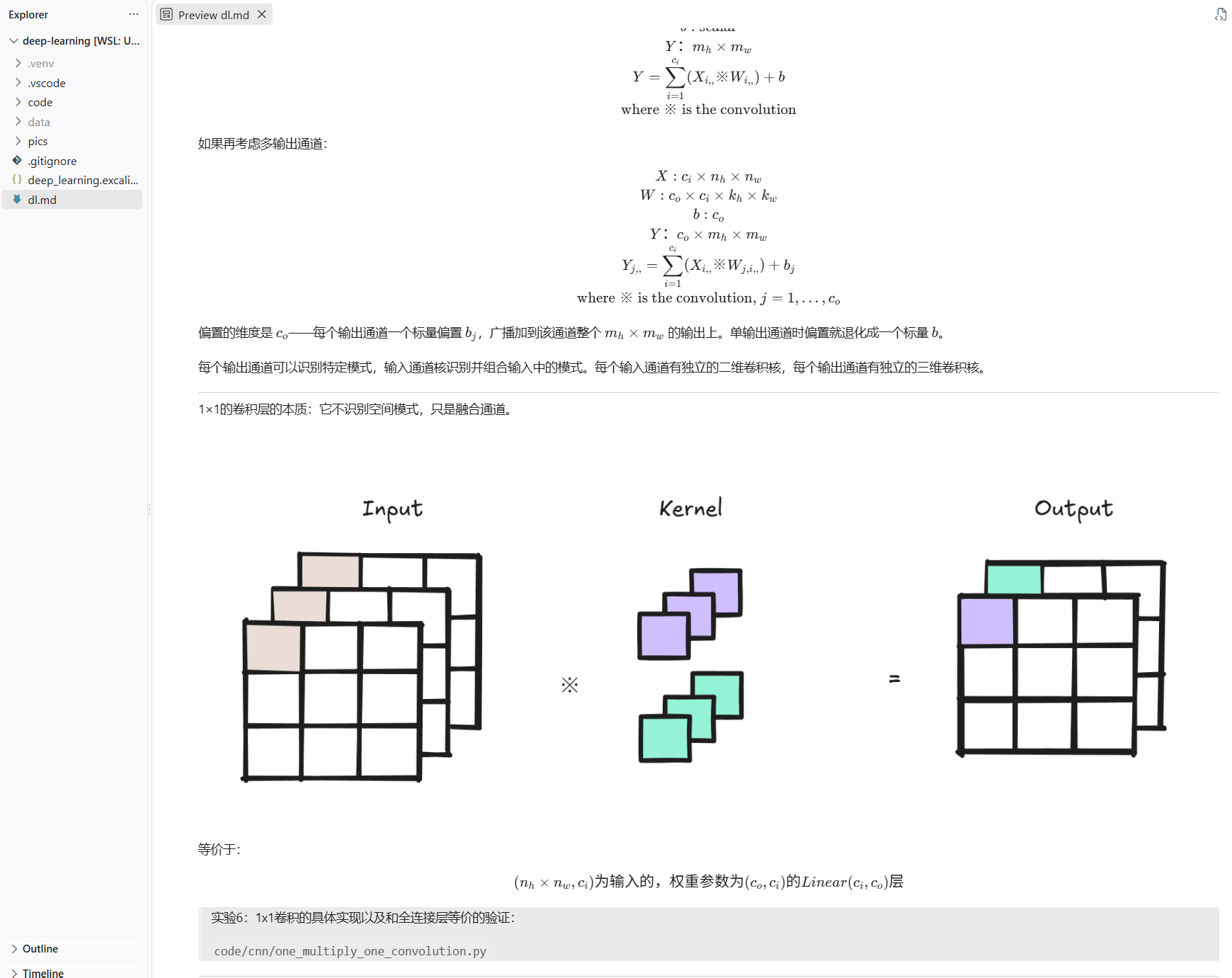
Kehan also said that if I truly loved what I want to do, I’d already have a demo built by now instead of just talking about it. That’s a fair point. At my current stage, I often talk ahead of doing. Going forward, whenever I put something out there, I want it to be more about showing real work I’ve done, actual results—let the results speak. That’s why I deliberately put a screenshot of my current notes at the very top of this blog post: I’m doing real things! Maybe I’m once again “preparing” rather than doing first and iterating. But I think my current stage isn’t really entrepreneurship in the strict sense—I’m doing a PhD. A lot of things require depth, require foundations, require systematic learning and organization. The preparation I’m doing now serves the things I want to do later. If not having a good demo yet means I don’t truly love it, well, I don’t think passion has to mean recklessly rushing out a demo right away. Knowing what stage you’re at and doing what that stage calls for—I don’t think that means I don’t love this. I’m also somewhat confused about whether “entrepreneurship means having guts, seizing the timing, and immediately iterating on a demo, otherwise you’re not cut out for it” applies to my current stage at all. I don’t know whether my approach—painstakingly learning systematically, building solid foundations, reading papers, and making demos at the right stage—is correct. But what I wrote above is just my current view. I think it’s probably a choice between timing and depth, a tension that has probably existed throughout history and needs case-by-case analysis. Frankly, my current understanding is still too limited, and I don’t know whether my choice is right.
Here’s another issue I have: often what I say is right after careful deliberation, but in the live moment of a conversation, when I have to speak in real time, a lot of what comes out is wrong. It’s not that I don’t have the correct understanding—it’s that it hasn’t yet become an instinctive, subconscious reflex. That still takes practice and reps.
My biggest problem, perhaps, is that my drive to earn other people’s approval is stronger than my drive to actually get things done. I have to deeply reflect on whether I’m doing this to show off to outsiders, or to build real things and actually make them work. I want the latter to grow and the former to shrink going forward. This doesn’t mean the former isn’t needed—the latter must be the primary engine, and the former can only be the auxiliary one. To be fair, I absolutely do have the latter drive, and it’s not small. But the former is probably genuinely substantial too—most likely even bigger—and I don’t think it should be that big. Shifting from motivation born of lack to motivation born of the obsession and love that come from actually doing the work is one of my most important life lessons. This is a question I must reflect on deeply, and it’s urgent.
Kehan also said I’m not focused enough—that I’m doing too many things, too scattered. I think he has a point there.
All in all, Kehan isn’t necessarily right about everything, but he is definitely more experienced than me, and his understanding of science and entrepreneurship is ahead of where I am now. Even though the conversation only lasted 20 minutes and I blew it, I think it did me a lot of good in understanding my own problems at this stage more deeply.
These are the things I’ve been doing lately, and my recent reflections. I hope that for the things I haven’t figured out clearly today, one day in the future, when I look back at these questions, I’ll have my own answers.
One more takeaway: if the purpose of a meeting or an event you’re about to attend is vague, the best move is to confirm both sides’ expectations right at the start—and if it turns out to be a mismatch, don’t hesitate to walk away. Don’t waste time. Everyone’s time is precious. I finally understand why, in past conversations, some people opened by asking me straight up what I wanted. Their time is expensive. We should all respect each other’s time.